

Met Police have a command unit targeting phone theft, Apple upgrade protections through Activation Lock, and Stolen Protection features. Phone theft is dropping but still unnervingly common.
Summary and key points TLDR
- Phone theft is falling in London, it is currently around 112 a day
- In February 2026, the London mayor announced a new mobile theft Command cell, supported by £4.5million in funding
- The Met police have a fleet of e-bikes to pursue suspects that has expanded from an initial five to twenty-five
- The Met have been testing live-recognition camera units to identify suspects.
- Despite falling theft numbers, recovery rates remain low — only around 2% of phones stolen between 2017 and 2024 were recovered
- Charge rates are also very low (under 1% in London), reflecting the practical difficulty of prosecuting street snatch theft
- The new Crime and Policing Act (Royal Assent 29 April 2026) will let police enter properties without a warrant to recover electronically tracked stolen phones — though this specific power hasn’t been switched on yet, and even once active it requires senior-officer authorisation
- Organised crime is a major driver: stolen phones can move from London street thefts through resale chains into markets like China, Dubai, and parts of Africa and Eastern Europe
- Reporting a stolen phone is still worthwhile — it generates a crime reference number for insurance, and the IMEI can be logged with the National Mobile Property Register to restrict resale
- Apple’s Activation Lock, Lost Mode, and Stolen Device Protection features are designed to make stolen iPhones unusable and harder to strip for parts
I was risk averse and overflowing with trepidation when I first moved to London. As others before me have, I suddenly went minimalist, sold my relics on Facebook marketplace and donated the rest. Left with my life squashed into two suitcases and a backpack, my phone metamorphosed from an essential into an existential essential.
Several weeks into the room and job hunting grind, I learnt that phone theft was rampant in London. Cue 2025, and London’s Major, Sadiq Khan and the Metropolitan police are trying to improve the reputation of London as a “safe city,” in part by focusing operations and funds towards crime reduction. The Metropolitan Police published in February 2026 that recorded thefts of mobile phones has fallen from 81,365 in 2024 to around 71,391 in 2025 in London. In August 2026, the Met reported that phone thefts were continuing to fall, with 3,500 phone thefts recorded in July (around 112 a day, despite the annual average being higher). Crime in Westminster , a known hotspot, dropped 40%, and the typical borough saw a reduction of 8.9%.
In February 2026, Sadiq Khan announced a new mobile theft Command cell. Additionally, £4.5 million was assigned to coordinating intelligence and aiding active responses to phone theft in hotspot areas such as the West End. The police have increased physical presence in areas that are hotspots for theft, as well as increasing awareness through webpages on how to avoid theft in public.
Use of cameras with live facial recognition, drones and e-bikes to track thieves
You may have seen the Met testing live facial recognition cameras on Oxford St. The cameras can be effective even when the wearer is wearing a Balaclava, as it uses multiple biometric data points from live feeds to compare with a watchlist and database of people. If the person is not already on the database, then their data will be deleted immediately, and no one will be notified. However, the police can retrospectively use other means to identify culprits. Additionally, drones are used for live-tracking, and Sur-Ron electric dirt bikes are being used to keep up with thieves on e-bikes, although officers will prioritise public safety as pedestrians can be around. The fleet of e-bikes recently increased from five to twenty-five.
What happens when you file a report for a stolen phone?
If your phone has been stolen, you can report it to the police via phone, calling 101, or through an online form. They will issue you a crime reference number (CRN), which can be used for insurance claims. If you also have your International Mobile Equipment Identity number (IMEI), it can be entered into the National Mobile Property Register (NMPR) registry to flag the phone as stolen goods, that affects resellers’ legal obligations to refuse sale.
Unfortunately, it seems like the chances of recovery are not great
Between 2017 and 2024, out of the 587,498 phones stolen in London, only 2% were recovered, without detail on how far after the theft occurred the phones were returned to civilians. If you’ve seen from the reddit posts, numerous victims of phone theft have found their stolen devices on Find My, and when contacting the police, still had no recourse for various reasons to retrieve it, usually attributed to low-priority and understaffing.
The government is increasing the police’s power to search homes
Kier Starmer’s UK government announced in 2025, and passed into law 29 April 2026, the Crime and Policing Act. The police have new powers to search properties without a court warrant to retrieve mobile phones and other electronically tracked items such as tagged bikes, and laptops. This is an amendment to the Theft Act 1968. Despite the law being passed, no commencement date has been set yet. Of course, Find My is not fully capable of for example pinpointing a floor of an apartment building, but this is a step in the right direction.
What part is the law playing?
People describe phone theft as nearly “decriminalised.” Only 90-95% of cases are closed, with less than 1% resulting in a charge in London. The number of charges may seem low, but are being lawfully issued according to each individual circumstance of the theft, as said by Jamie Robinson, a crime reduction adviser for Surrey Police in a Surrey Live article. Variables include for example where the phone was taken – on a street or inside a home – and whether force was used. Storing and transporting stolen goods for resale has its own repercussions.
Addressing organised crime
Outside of individual cases, police operations have recovered thousands of phones. In late 2025, the Met police recovered more than 2,000 stolen devices across properties in London and Hertfordshire. During recent raids, the Met Police noted that thieves at the first stage of theft, were able to be paid up to £300 for a phone. Further down the chain, devices were found to be wiped and sold in China for up to £4,000, where the phones are made to different regulations and can bypass national censorship laws. Other markets where phones have shown up in include Dubai, Algeria, Morocco, Romania and Bulgaria, as reported by the BBC.
Beware compromised data access during theft as a motivation, or prior to on-selling
If thieves view your passcode “over your shoulder” and grab your phone unlocked, then they may be able to access sensitive data and accounts. And in other cases, the phones are sold for parts.
Deference and recovery approach from Apple
Back in 2013, Apple introduced a Kill Switch. New York pushed for this as part of their Secure our Smartphones (SOS) initiative, of which previous London Mayor and Prime Minister, Boris Johnson was a co-chair of. At the time, 3.1 million mobile phones were recorded as stole in the United States, again with iPhones being prolific targets, with the act dubbed “apple-picking.” The Kill Switch at the time, was an opt-in Activation Lock – intended to prevent thieves from turning off Find My iPhone, and then making the phone inoperable without the owner’s iCloud credentials.
Activation Lock
Presently, the Activation Lock defers re-activation. It’s a part of the Find My feature, and turns on automatically when Find My is setup. This is intended to deter reselling the phone for parts, whereby components removed from a locked device remain linked to the original owner’s Apple account. This includes things like the battery, display, camera and biometric sensors. Newer phones cannot configure the pieces without iCloud access. If someone tries to by-pass unlocking the phone by wiping it, a reboot of the device will trigger an attempt to retrieve a certificate and will not proceed unless verified.
Lost mode
This Apple feature locks the phone, displays a customisable return and contact message. It is intended to block access from the phone being used. Putting the phone into lost mode, and also erasing the data from your phone if you think it is compromised can be done via your iCloud account, see here for steps.
Stolen Device Protection
Separate to the Activation Lock, this stops someone from changing private account settings like the device passcode and Apple account password when the iPhone is in unfamiliar locations, e.g. away from work and home.
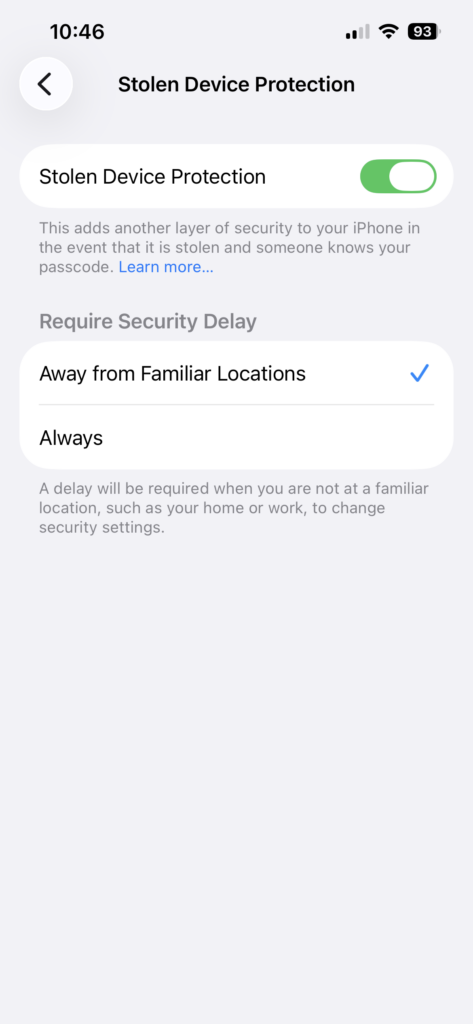
Overall the Met Police’s efforts are focused on stopping phone theft in the immediacy of the event, and targeting larger organised crime. Individual recovery cases seem to not be able to receive resources that can feel imbalanced in relation to the personal stress of losing a phone. Apple has enabled Activation Lock, and Stolen Device Protection to deter thieves and resellers – it’s not apparent if they are able to bypass these. The step-up in protections coincides with a reduction in reported thefts. There are also plenty of additional steps that individuals can take to protect and prevent theft from their person, which I will collate in another post. The reddit community is extremely helpful!
Full circle to my deep dive on keeping my phone and digital life a bit more secure, I designed and use these scrunchie straps – they’re elastic, comfortable, visible, useful and multi-purpose. It will not provide an absolute guarantee from theft prevention. I designed something that I believe would keep my phone on me, and also reduce risk of injury if someone did try to grab it anyway. Using it on the tube and out in public is second nature to me. Link is here, and purchase includes free-shipping in the UK.